











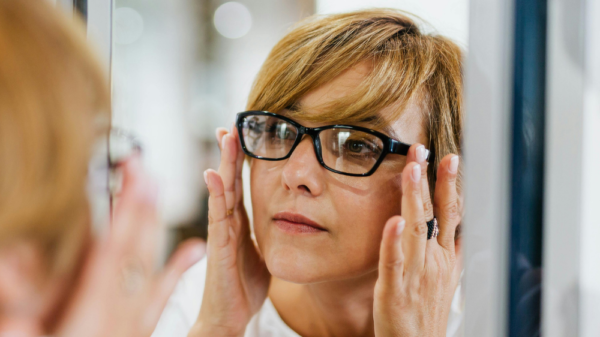
















































For most of the twentieth century, needing vision correction at multiple distances meant accepting a visible line across your lenses — and everything that came with it. Bifocals worked, but they announced themselves. They carried connotations. They were, for many people, something to put off as long as possible. Progressive lenses changed that calculation, and the shift has been more significant than the optical industry often gets credit for.
The Problem Progressives Were Built to Solve
Human vision doesn’t operate in two discrete focal zones. We move fluidly between distances all day — from a screen to a room to a face to a dashboard to a menu — and traditional bifocals forced an artificial binary onto that continuous spectrum. You had your distance zone and your reading zone, separated by a line that your eye had to consciously cross.
Progressives eliminated the line and replaced it with a gradient. The upper portion of the lens handles distance, the lower portion handles near, and the middle corridor handles everything in between — arm’s length, computer screens, instrument panels. For most people who need multifocal correction, this more closely mirrors how vision actually works throughout the day.
Progressives, Bifocals, and Reading Glasses: Understanding the Difference
The choice between lens types isn’t purely aesthetic, and it isn’t one-size-fits-all. Each option serves a different need, and understanding the distinction is the first step toward making the right call with your optometrist.
Reading glasses are the simplest intervention — single-vision lenses optimized for close work. They’re appropriate for people who have good distance vision but need help at near. The limitation is obvious: you take them on and off constantly, and they do nothing for intermediate distances.
Bifocals divide the lens into two segments with a visible line. They’re durable, predictable, and optically efficient within each zone. Some wearers — particularly those who’ve worn them for years — find the distinct zones easier to navigate than the gradient of a progressive. For specific occupations or visual needs, they remain a legitimate choice.
Progressive lenses offer the most complete correction across the full range of distances, but they come with an adaptation period. The peripheral areas of the lens have some distortion, and new wearers often need a week or two to learn how to position their gaze naturally within the lens. A detailed comparison of how these options stack up across different use cases — including cost, adaptation time, and candidacy — is worth reviewing before making a decision. Resources like this breakdown of bifocals, progressives, and reading glasses can help frame the conversation before your next appointment.
What’s Changed in Progressive Lens Technology
Early progressive lenses had a narrower usable corridor and more pronounced peripheral distortion than modern versions. The past two decades have brought significant improvements: freeform digital surfacing technology allows labs to customize the lens geometry to the individual wearer’s prescription and frame measurements rather than relying on standardized molds.
The result is a wider intermediate zone, reduced swim effect during adaptation, and better low-light performance. High-index progressive lenses have also allowed thinner profiles at stronger prescriptions, removing one of the historic aesthetic objections to multifocal wear. Premium progressive designs from manufacturers like Zeiss, Essilor, and Hoya now offer meaningful differences in optical performance — a category where not all lenses are created equal.
Having the Right Conversation With Your Eye Doctor
The biggest obstacle to choosing the right multifocal lens is usually the conversation that doesn’t happen. Patients often accept whatever the practice recommends without describing their actual daily visual demands — and the recommendation can only be as good as the information it’s based on.
A few things worth discussing: how much time you spend at a computer versus reading physical materials, whether you drive frequently at night, what your primary occupation requires visually, and whether you’ve worn progressives before and how that experience went. The answers meaningfully affect which lens design, corridor length, and index will serve you best.
The shift away from bifocals toward progressives has been one of the quieter revolutions in everyday optical care. For most people who need multifocal correction, the technology now exists to get it right — the conversation just has to happen first.